+86 13638632902
 Jason@cleanroomequips.com


 MENU
MENU
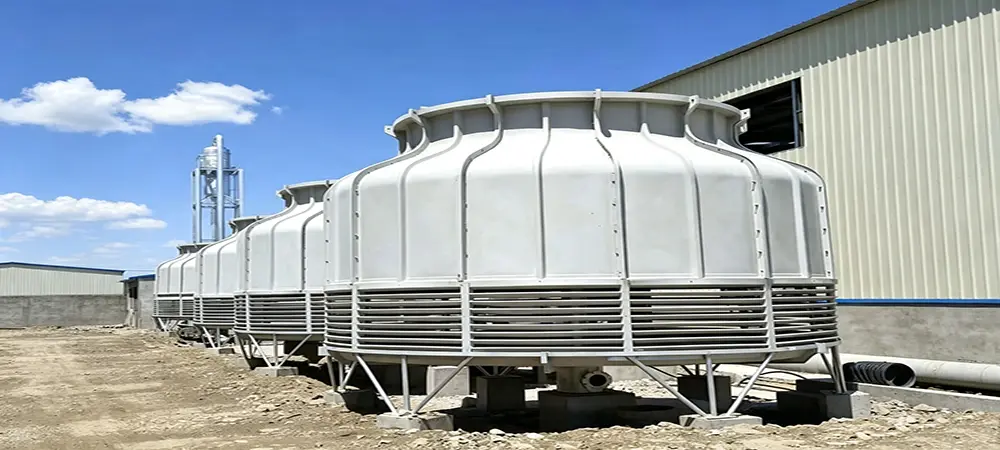
The following document outlines the Cooling Tower Installation Requirements for the project engineers, commissioning agents and facility managers.Proper installation of a cooling tower is vital to the thermal performance, energy effICiency and reliability of associated equipment.Following Cooling Tower Installation Guidelines to the letter can prevent recirculation, structural misalignment and premature part failure.Data shows that greater than 2% levelness deviation can reduce bearing life for fan bearings by as much as 40%.
A tolerance error of just 5mm beyond specification for the cooling tower foundation can result in long-term problems with pipe stress, and even cracking of the basin.
Relevant building codes and industry standards include CTI STD-137/STD-201, ASHRAE 90.1/189.1, OSHA, IEC 61400, GB 50050/50016, GB/T 7190 and local noise ordinances.
These cooling tower installation Requirements must be verified during the pre-startup commissioning tests to ensure that all installation requirements have been met and the tower is ready for handover.
1q9fHC_shVc
Model, Specs, and Technical Compliance
design Fit and Smooth Operation
Deiiang™ ensures that every cooling tower model and specification are in line with the designers’ project design documents.
Deiiang™ verifies nameplate data—flow rate, heat rejection capacity, fan power—against design parameters before shipment.
Even a difference of only 5% in design flow can already lead to a decrease in efficiency of the overall system of 8% - 12%.
The rules for cooling tower installation must be adhered to strictly.
Levelness and Plumb Tolerance
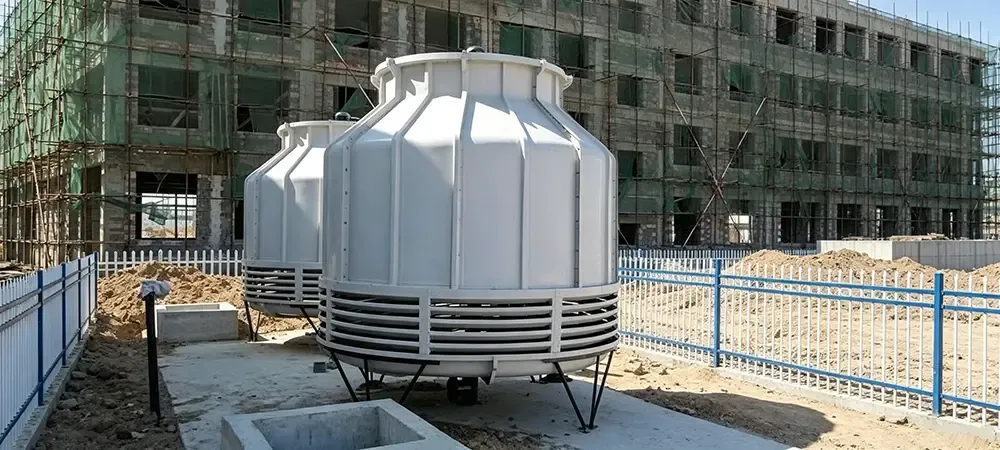
Single-tower installation requires both horizontal levelness and vertical plumb within 2%.
For a tower standing 4,000 mm tall, this translates to a maximum deviation of just 80 mm at the top relative to the base centerline.
Use a calibrated digital inclinometer with ±0.1° resolution for verification.
Foundation Elevation Tolerance
Foundation elevation must meet the design specification with an allowable error of ±20 mm.
This cooling tower foundation tolerance is critical—exceeding it can cause uneven water distribution and compromise structural load paths.
Siting, Setbacks, Recirculation, and Environmental Controls
Upwind Placement vs Building Minimum-Frequency Wind Direction
The position of Cooling Towers on a building should be upwind of the minimum-frequency wind direction.
This siting strategy will minimize the chance of exhausted humid air returning to the tower intakes.
Even in urban environments with typical wind direction (e.g. a prevailing south wind) for such locations of cooling towers on the north side of buildings can decrease recirculation rates up to 60-75% in comparison with downwind placement.
Avoiding Recirculation and Ensuring Access Space
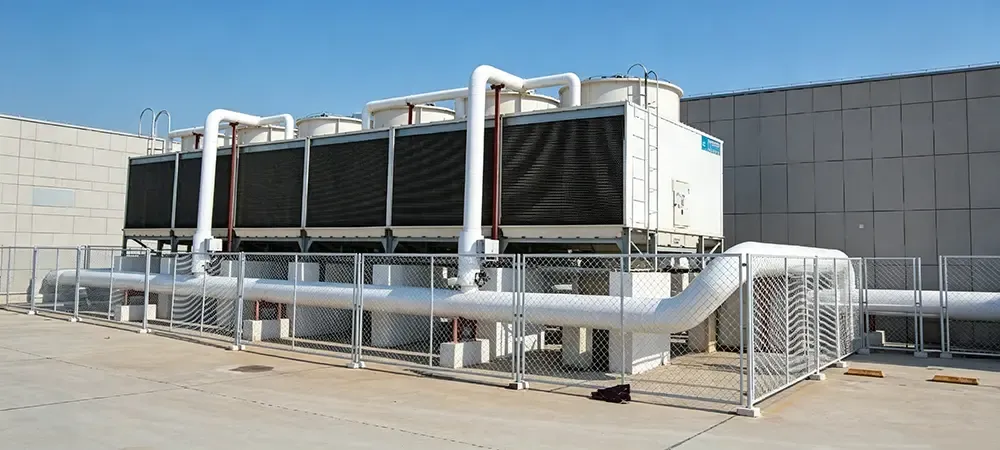
Sufficient clearance must be maintained around eACH tower for piping, ancillary equipment, and maintenance access.
Deiiang™ recommends a minimum 1.5× the tower width as side clearance for single-sided air intake models.
Recirculation can be quantified using CFD modeling—acceptable thresholds are typically below 5% of total intake air.
Multi-Tower Spacing and Building Setbacks
Inter-tower spacing must prevent mutual interference when multiple towers are arranged in a bank of towers.
Inter-tower spacing is also to be considered in bank of towers in order to prevent mutual interference.
For mid-sized air intake opening, towers should be set back from building walls a minimum of 3 m.
These cooling tower installation guidelines also attempt to create proper airflow.
Localization Tip: Consult your city's wind rose data and local noise ordinances when finalizing tower placement. Deiiang™ provides site-specific CFD assessments linking wind patterns to predicted recirculation risk.
HydraulICs: Nozzle Orientation, Uniform Distribution, and Basin Integrity
Outlet and nozzle directions as per design drawings to be positioned correctly.
The rotating water distributor is designed to move freely and all spray nozzles should be pointing in the same direction.
Deiiang™ outlet direction is preset at the factory within a tolerance of ±1.5° to ensure uniform water distribution.
Leak test for the Collection Basin: A 24 hour static water test must be conducted to test for any leaks prior to handing over for commissioning.
The distribution of water is uniform. The flow is measured at 6-8 points distributed across the basin.
Flow variation should not exceed ±10% of the mean value.
This cooling tower installation guide provides particular focus to the crossflow cooling tower, in which uneven distribution of water can decrease thermal performance by as much as 15%.
Outlet and nozzle directions aligned to design specification
Rotating distributor spins freely; all nozzles oriented uniformly
Collection basin passes 24-hour static leak test
Flow variation across basin sampling points ≤ ±10% of mean
Fan Assembly: Tip Clearance, Blade Angle, and Tower Bank Leveling
The radial clearance between fan blade tips and the tower casing has to be the same all the way round.
The 2400mm fan should have 8-12mm of radial clearance between the fan tips and the tower casing with a variation of no more than ±2mm.
All adjustable-pitch blades must be set at the same angle.
This extra force can translate into extra loads on the motor bearings, in the order of 15 to 20 kg for each degree of asymmetry.
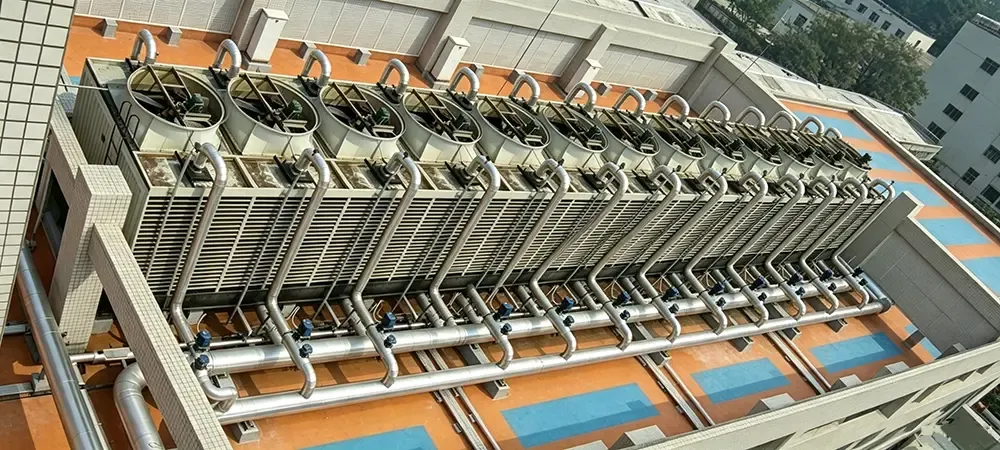
For multi-tower banks, the water surface in all towers should not differ by more than 30 mm.
These values are checked with Laser leveling during the commissioning of the Deiiang™ coolers.
Uneven water levels create uneven flow which in turn will affect the overall efficiency of the Cooling System.
Fan tip radial gap: uniform ±2 mm across full circumference
Adjustable blades: all set to identical pitch angle
Multi-tower water surface height difference: ≤30 mm
Laser leveling verification recommended for banks of 3+ towers
Small tolerances drive big outcomes: keep plumb and level within 2%, and you'll avoid 80% of commissioning headaches.
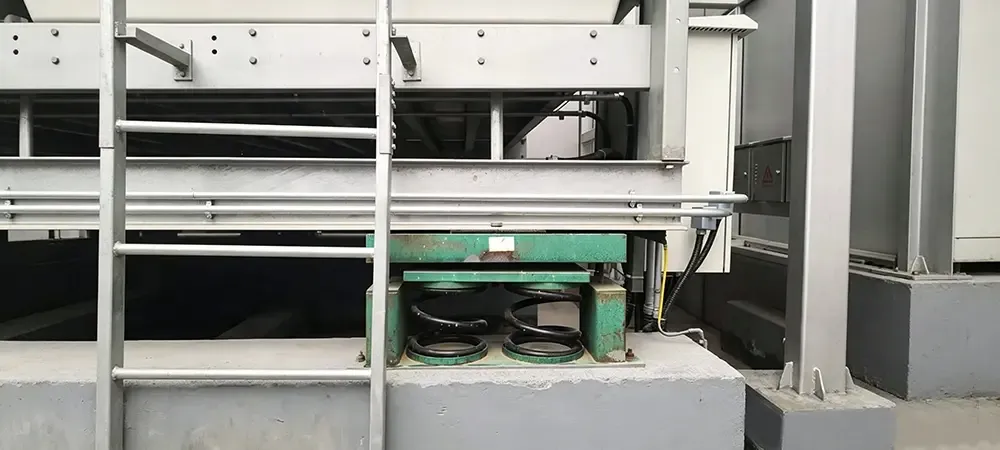
Foundation Steel, Fastening, and Corrosion Protection
Foundation Steel Fabrication and Edge Treatment
Foundation steel profiles must be fabricated neatly with a uniform finish coat.
All edges in walkways should be ground smooth to a radius of at least R3 mm.
This attention to detail in cooling tower installation requirements prevents injuries and reflects installation quality.
Anchor Bolts and Embedded Plates
Anchor bolts must be securely fastened using hot-dip galvanized or stainless steel hardware.
All fasteners should protrude uniformly—bolt length variation should not exceed ±3 mm.
Embedded steel plates require precise positioning.
The top surface elevation tolerance is ±1 mm, and the center-to-center distance tolerance is ±2 mm.
Meeting this cooling tower foundation tolerance demands survey-grade measurement tools.
Piping Supports, Hot-Work Controls, and Safety
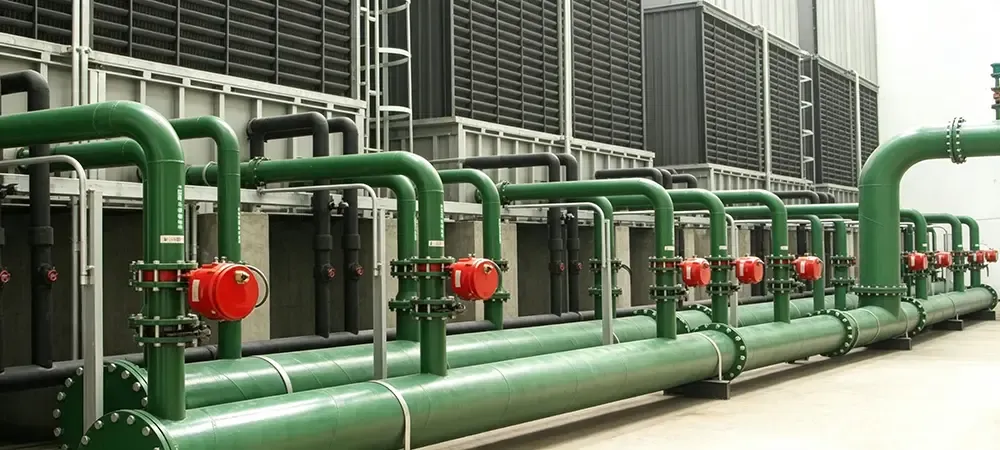
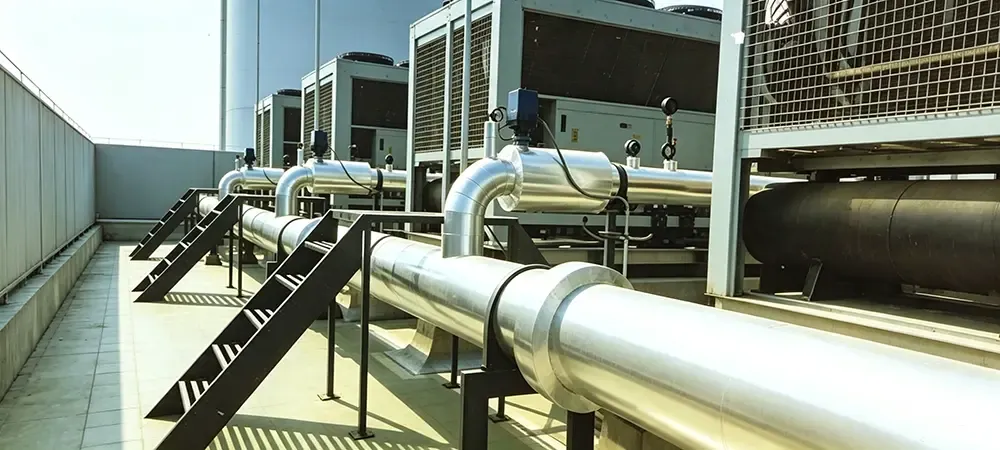
Inlet, outlet and make-up water pipes are to be supported by independent pipe stands.
NEVER rely on the tower for support of the pipes.
A DN200 steel pipe, containing water, has a static load of more than 450 kg per meter.
All pipe supports must be anchored to the building structure or on dedicated concrete pads.
No welding or open flames on the tower body.
If hot work is to be carried out then a formal hot-work permit must be issued.
Fire-resistant blankets with a rating for >1,000°C must be used to cover FRP and PVC components within a 3 m radius.
Note: These rules for cooling towers are set out by OSHA (and other international safety codes).
Safety Reminder: Remember this important note – never bypass the hot-work permit process for your safety. Check out the pre-commissioning safety checklists that Deiiang provides for your compliance to OSHA 1910.252.
Lightning Protection and Grounding
Equipment projecting above a metal roof must be integrated into the building's overall lightning protection mesh.
A dedicated lightning rod must be installed on the equipment at an effective location.
The rod height must satisfy the protective angle method.
For Class II protection, the protective angle is 45°.
A rod extending 1.5 m above the tower top protects a ground-level radius of approximately 1.5 m directly beneath it.
Deiiang™ engineering teams calculate the rolling sphere radius per IEC 62305 to confirm full equipment coverage.
Continuous grounding connection to building mesh
Dedicated lightning rod with calculated protective height
Protective angle verification per IEC 62305 or GB 50057
Ground resistance ≤10 Ω recommended
Backflow Prevention, Insulation Protection, and Access
Backflow Prevention
The top surface of the tower foundation must sit higher than the top surface of the return water main.
A minimum elevation difference of 50 mm is recommended.
This creates a positive gravity drain slope of approximately 0.5–1% toward the system return.
This detail is often overlooked in cooling tower installation requirements yet is a common cause of water hammer and basin overflow.
Insulation and Access Protection
Pipe insulation cladding should be installed neatly and durably.
In areas where personnel must walk across piping, small arch bridges should be constructed over the insulated pipes.
These bridges protect the insulation from foot traffic damage while providing safe access.
Deiiang™ specifies aluminum chequer plate arch bridges with a minimum load rating of 150 kg/m².
Deiiang™ Product Data and Compliance Advantages
Deiiang™ cooling towers are engineered to meet and exceed the most stringent cooling tower installation requirements globally.
Below are verified performance metrics backed by third-party testing and CTI Certification.
Actual test report numbers should be inserted upon publication.
| Metric | Deiiang™ Model DX-Series | Standard Limit / Industry Average | Test Standard / Report No. |
|---|---|---|---|
| Drift Rate (high-efficiency eliminator) | ≤0.002% of circulating flow | ≤0.005% (typical) | CTI ATC-140 / Report: DX-DR-2026 |
| Fan System Efficiency | ηsystem ≥ 62% | ≥55% (industry avg.) | iso 5801 / Report: DX-FE-2026 |
| Sound Power Level (A-weighted, 1 m) | ≤65 dB(A) at 75% load | ≤72 dB(A) | ISO 3744 / Report: DX-SL-2026 |
| Corrosion Protection (HDG thickness) | ≥85 μm; C5 salt spray ≥720 h | ≥70 μm; C5 ≥480 h | ISO 12944 / ISO 9227 / Report: DX-CP-2026 |
| Metric | Deiiang™ DX-Series |
|---|---|
| Drift Rate | ≤0.002% of flow (CTI ATC-140) |
| Fan Efficiency | η ≥62% (ISO 5801) |
| Sound Level | ≤65 dB(A) @75% load (ISO 3744) |
| Corrosion (HDG) | ≥85 μm; C5 ≥720 h (ISO 12944) |
Overall Compliance Score: Deiiang™ DX-Series vs. Industry Baseline
Industry Average Baseline
Industry Case Studies — Deiiang™ in Action
CASE A: BioPharmaceutical Plant
Challenge: Ultra-low noise requirement (≤58 dB(A) at site boundary), strict drift control, and rooftop load restrictions.
Solution: Deiiang™ deployed variable-pitch fans with dual-stage drift eliminators achieving 0.002% drift rate, plus lightweight foundation steel.
Result: Noise reduced by 7 dB(A); annual energy savings of 12%; full compliance with local environmental noise ordinance.
CASE B: Data Center
Challenge: N+1 redundancy, recirculation risk in compact layout, rapid maintenance access required.
Solution: CFD-optimized tower arrangement; independent pipe gallery supports; dedicated fast-access maintenance corridors.
Result: PUE improved by 0.03; zero summer recirculation alarms over 18 months.
CASE C: Electronics cleanroom Facility
Challenge: Adjacent cleanroom requiring ultra-low drift and superior corrosion resistance.
Solution: Dual-stage drift elimination with closed-circuit transition section; C5-rated coating system.
Result: Settling salt spray significantly reduced; HEPA filter lifespan extended by 18%, saving about $42,000 annually.
Installation and Commissioning Checklist
Levelness / Plumb: ≤2% (verified with digital inclinometer)
Foundation Elevation: ±20 mm; Embedded Plate Elevation: ±1 mm
Embedded Plate Center Distance: ±2 mm
Fan Tip Clearance: Uniform ±2 mm; Blade Angles: Identical
Water Distribution: Nozzle direction correct; basin leak-free
Piping: Independent supports installed; no load on tower body
Hot Work: Permit issued if applicable; fire blankets in place
Lightning Protection: Rod height verified; grounding resistance ≤10 Ω
Multi-Tower Bank: Water level height difference ≤30 mm; spacing uniform
Backflow Prevention: Foundation top surface above return main top surface
Frequently Asked Questions
Q: How do you calibrate 2% levelness/plumb on a sloped roof?
A: Use adjustable steel base frames with integrated leveling screws.
Deiiang™ supplies a roof-adaptation kit for Deiiang™ steel base frames, enabling slopes up to 5% and at the same time ensuring that plumbness is within the 2% required tolerance.In verification of levelness for roof mounting, a laser level must be compared to a fixed benchmark off the roof slope.
Q: How are urban noise regulations used for determining a tower’s location and acoustic design?
A: This typically is specified by city noise ordinances to be between 55 dB(A) and 65 dB(A) at the property line of affected buildings.
Intake and discharge attenuators, variable speed operation for quiet night time operation, or alternative locations further away from sensitive receptors.
Deiiang™ provides acoustic modeling for site specific Cooling Tower Installations.
Q: How can drift rate and recirculation risk be verified on site?
A: Drift can be measured using the sensitive paper method (CTI ATC-140) or tracer gas techniques.Recirculation can be detected by placing temperature/humidity sensors at the intakes of the cooling towers.A reading greater than 0.5°C indicates recirculation and the need for design modification using CFD as part of site specific cooling tower installation guidelines.
Ready to Ensure a Flawless Cooling Tower Installation?
Download our detailed installation node drawings and commissioning checklist. Schedule a Deiiang™ site walk-through and CFD assessment today.
Visit Deiiang.com →
Download our detailed installation node drawings and commissioning checklist. Schedule a Deiiang™ site walk-through and CFD assessment today.
Visit Deiiang.com →
References
CTI STD-137 — Cooling Technology Institute
CTI STD-201 — Certification Standard for Cooling Towers
ASHRAE 90.1 / 189.1 — Energy Standard for Buildings
OSHA 1910.252 — Hot Work Safety
IEC 62305 — Lightning Protection Standard
GB 50050 / GB 50016 — Chinese National Building & Fire Codes
GB/T 7190 — Cooling Tower Specification (China)
ISO 5801 / ISO 3744 / ISO 12944 / ISO 9227 — International Organization for Standardization
EN ISO 12944 / 9227 — European Corrosion & Coating Standards
© 2026 Deiiang™. All rights reserved. Product Designer: Jason.peng. Specifications subject to change without notice.