+86 13638632902
 Jason@cleanroomequips.com


 MENU
MENU
Abstract: Instead of mobile scaffolding for mechanical installation and finishing work in clean rooms, cleanroom scissor lifts have become the alternative of choice. The illustrated cleanroom construction guide explains the Scissor Lift Structure of cleanroom scissor lifts, their daily check list, the charging of cleanroom scissor lifts as well as Cleanroom Construction Safety. Deiiang™ experience and case studies are explained to provide relevant data for choosing the best cleanroom scissor lift to avoid delay and to operate in clean rooms safely up to iso class 5 – 8 without any incident.
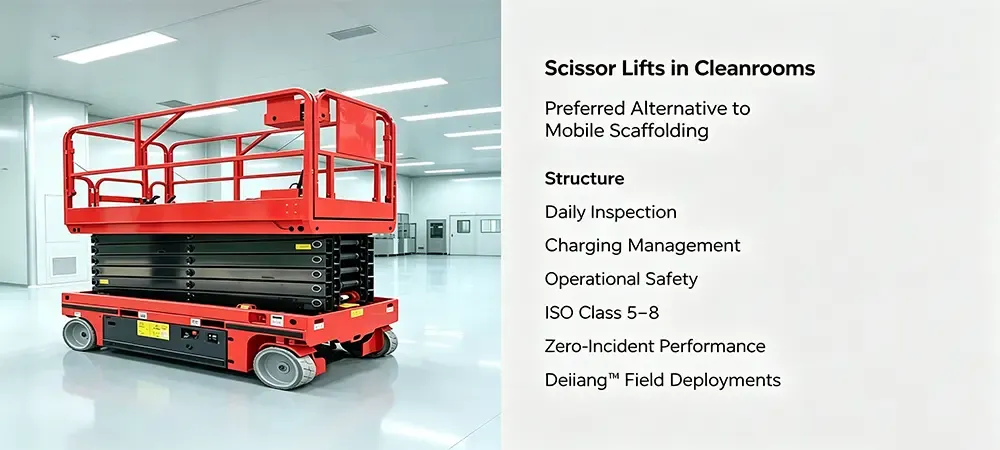
Scissor Lift Structure Overview
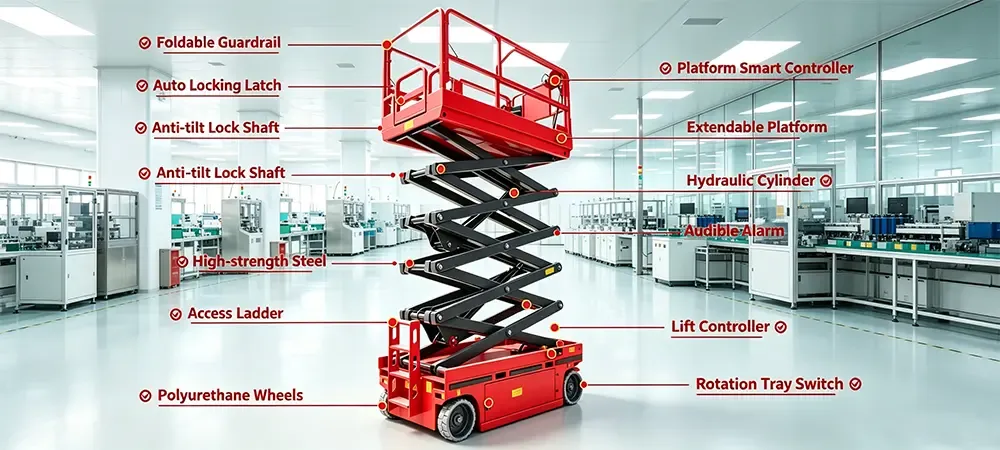
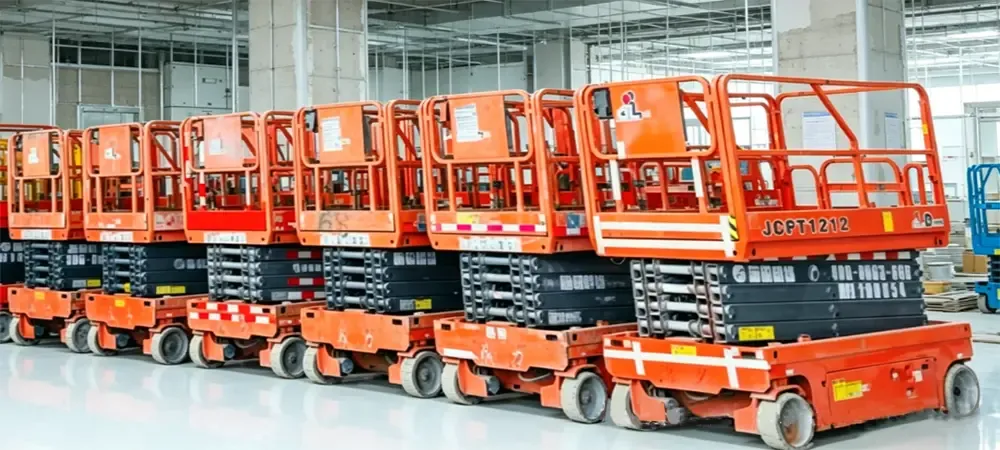
Understanding the make up of the Scissor Lift Structure is crucial to safe use of any scissor lift in a cleanroom. An electric cleanroom scissor lift consists of six key parts all working in unison for safe use of the operator. The chassis is mounted with Non-Marking tires ensuring no marks or damage to the cleanroom floor. The Scissor Linkage is a Cross-Braced structural frame allowing the lift to go up and down. The Hydraulic Cylinder is used to drive the lift up via the scissor frame. The Battery Pack is a DC power source giving mobility to the lift around cleanroom.
The Platform complete with Guardrails has an automatic locking gate for safe use of the lift and the last part of the structure is the Dust-Proof wheel sleeves, made specifically for use in cleanrooms as part of the cleanroom scissor lift design. A Limit Switch is positioned above the operator’s head at the maximum height of the lift to prevent over extending the lift. An Emergency Stop button is also positioned on the controller to immediately cut power to all parts of the lift. This all enhances Cleanroom Construction Safety.
Key Deiiang™ Cleanroom Scissor Lift Specifications (suggested placeholder data):
Rated Load: 230 kg – 450 kg (varies by model)
Max Platform Height: 5.8 m – 10.2 m
Battery Endurance: 6–8 hours continuous operation
Turning Radius (inside): ≤ 1.6 m for narrow cleanroom aisles
Dust-Proof Sleeves: iso class 5 compatible anti-static material
Designed by Jason.peng, the Deiiang™ cleanroom scissor lift lineup emphasizes compact maneuverability and cleanroom-grade sealing — critical for Illustrated Cleanroom Construction projects where particulate control is non-negotiable. The robust Scissor Lift Structure ensures reliable Cleanroom Construction Safety.
Site Entry & Acceptance Inspection
Prior to allowing any cleanroom scissor lift to be delivered to a cleanroom job site, it is necessary to complete a thorough documentation review and physical acceptance inspection.
This process allows for full traceability and prepares the Cleanroom Construction Safety documents. Acceptance team consists of safety department, lessor and lessee representatives. All three sign off prior to acceptance by the lessor and lessee for use on their Cleanroom Construction project.
Below is the mandatory documentation list for scissor lifts that must be complete and up-to-date prior to acceptance by Cleanroom Construction Safety.
| Document | Description | Requirement |
|---|---|---|
| Manufacturer Qualification | Factory license & ISO certification | Valid & unexpired |
| Certificate of Conformity | Per-unit quality assurance document | Matches serial number |
| Third-Party Inspection Report | Structural & electrical safety test | Within 12-month validity |
| Insurance Certificate | Liability & equipment coverage | Minimum CNY 1M coverage |
| Lease Agreement | Lessor-lessee contract | Signed & stamped |
| Document | Status |
|---|---|
| Manufacturer Qualification | Valid & unexpired |
| Certificate of Conformity | Matches serial number |
| Inspection Report | Within 12-month validity |
| Insurance Certificate | Min. CNY 1M coverage |
| Lease Agreement | Signed & stamped |
Following receipt of all required documentation for processing, perform a physical acceptance inspection of the scissor lift cleanroom covers. This inspection is intended to ensure the following: Tire integrity (no visible cracks and proper inflation or that they are made of solid rubber); Hydraulic system integrity for any signs of leaks from all fittings and hoses; That limit switches function as intended at the maximum extended position of lift; That all electrical systems, including battery-powered units, are functioning properly (i.e. battery is at voltage of greater than or equal to 24V nominal; controller is functioning properly; emergency stop function is operating properly); And that all labels and warning decals are affixed to appropriate surfaces. Scissor lift operator license card, operating instructions and daily inspection sheet should also be displayed. These items provide the basis for Cleanroom Construction Safety.
⚡ Pro Tip: During acceptance of a cleanroom scissor lift, measure the limit switch height relative to the tallest operator on shift. It must be positioned at least 15 cm above the operator's head when standing upright on the platform — a quantifiable safeguard against crushing hazards, essential for Cleanroom Construction Safety.
Cleanroom Construction Safety Workflow
Working Cleanroom Construction Safety on a cleanroom scissor lift within a cleanroom environment requires a disciplined and reproducible workflow. EACH phase of the work, pre-operation checks, work positioning, dry-run testing, and manned operation, interlocks with the subsequent phase(s). Omitting a single step could rapidly lead to a critical incident in the confined spaces of cleanroom bays where overhead are installed HEPA filters and sensitive wall panels.
Pre-Operation Checks
The daily inspection routine for the cleanroom scissor lift should be completed and logged before the first lift of each shift. Use the checklist format below as a minimum baseline to uphold Cleanroom Construction Safety:
Tires: verify tread wear ≤ 2 mm variance; confirm dust-proof sleeves are intact.
Brakes: test parking brake on a 3° incline; service brake response < 0.5 s.
Hydraulic System: zero visible oil seepage; check reservoir level (dipstick mark).
Emergency Stop: press E-stop during idle; confirm immediate motor cut-off.
Platform & Guardrails: inspect welds, gate latch, and floor panel for cracks.
Limit Switch: manually trigger at upper travel; verify alarm sounds at 95% extension.
Battery: voltage reading ≥ 24.0 V under load; charge if below threshold.
Personnel & PPE Requirements
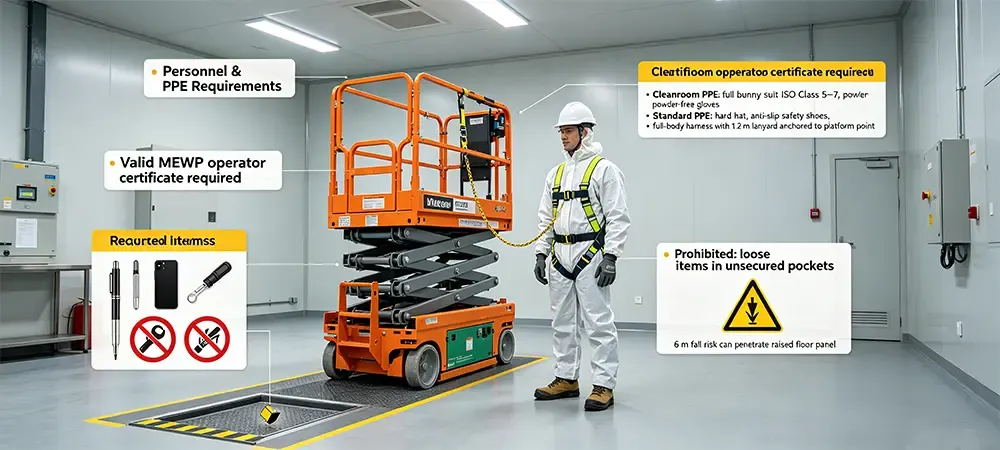
Cleanroom scissor lift operators must hold a valid MEWP operators certificate. In the clean area the standard PPE is hard hat, anti-slip safety footwear, and full body harness with 1.2m length of lanyard fixed to a safe working point on the platform. The Cleanroom specific PPE is bunny suit fully covered (ISO Class 5-7), powder free gloves and no loose items (such as pens, mobile phones and tools) in unsecured pockets as anything dropped from 6m height could penetrate a raised floor panel. These safety protocols are key to the Cleanroom Construction Safety.
Positioning & Dry-Run Testing
Drive the cleanroom scissor lift slowly (≤ 0.8 m/s) to the work position. Confirm all four wheels are fully grounded and the floor load capacity ≥ 500 kg/m². Inside cleanrooms, never drive over metal sandwich panels or exposed utility lines. Conduct 2–3 unloaded lift cycles through the full height range — observe for smooth acceleration/deceleration (ideally ≤ 0.3 m/s² jerk rate), zero abnormal noise (< 65 dB at 1 m), and correct limit switch activation. Such dry-run tests are a pillar of Cleanroom Construction Safety.
Manned Operation Rules (Quantified)
Load: ≤ 100% rated capacity of the cleanroom scissor lift; distribute weight evenly (max 60/40 front-rear bias).
Platform height vs. movement: Platform must be fully lowered below 1.5 m before any horizontal travel.
Speed: Elevated travel speed ≤ 0.5 m/s; cornering radius ≥ 2.0 m to avoid tipping.
Prohibited actions: No climbing on guardrails, no outward leaning beyond platform footprint, no makeshift step stools.
Spotter requirement: A dedicated safety observer must be present within 5 m line-of-sight at all times during elevated work — a non‑negotiable Cleanroom Construction Safety measure.
🛑 Emergency Protocol: Should an alarm sound or an unusual vibration be detected whilst an operator is in the cleanroom, the operator must, as a matter of urgency, press the emergency stop button, lower the cleanroom scissor lift platform using the auxiliary descent valve and inform the site safety supervisor of the incident within 10 minutes. Important: No attempt shall be made to carry out any repairs on the Cleanroom floor – a critical Cleanroom Construction Safety rule.
Charging & Battery Management
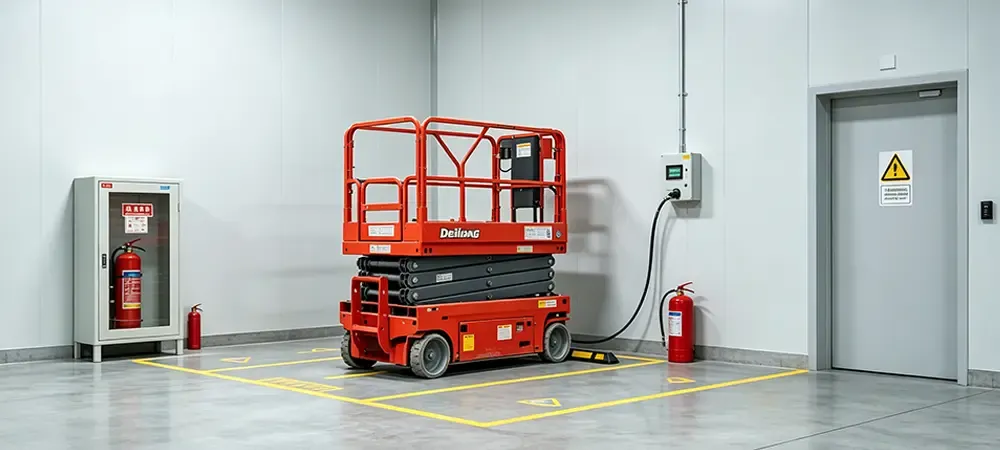
Cleanroom Scissor Lifts (Serving Illustrated Cleanroom Construction) Must Be Charged in Designated Charging Zones / Areas Never in Cleanrooms. The Charging Area(s) Must Be Located in Well Ventilated / Non Classified Areas Immediately Adjoining Cleanrooms. The Charging Areas Must Be Equipped With A Suitable Fire Extinguisher. Ideally A CO₂ or Dry Powder Extinguisher of minimum 5 kg capacity. Such must be located within 3 meters of the charging station. A dedicated attendant is to be present at all times when charging a cleanroom scissor lift. A timer controlled power switch must be used. It is to be set to auto switch off after 8 hours to avoid overcharging.
Deiiang™ Cleanroom Scissor Lift Battery Data (placeholder):
Battery Type: Deep-cycle AGM / LiFePO₄ (optional)
Cycle Life: 600–800 cycles @ 80% DoD (AGM); 2,000+ cycles (LiFePO₄)
Full Charge Time: 6–8 hours (standard charger)
Ventilation Requirement: ≥ 4 air changes/hour in charging zone
Product designer Jason.peng added a smart BMS (Battery Management System) to Deiiang™ brand electric cleanroom scissor lifts. The smart BMS shows a real time state of charge and will over heat to protect battery during long cleanroom construction shifts. A critical feature for Cleanroom Construction Safety.
Cleanroom Scissor Lift Battery Health Score (Example): 87% — Good
Deiiang™ Cleanroom Scissor Lift Case Study Snapshot
Project: Shanghai Zhangjiang Pharma Park — Sterile Injectable Facility, ISO Class 7 cleanroom ceiling HVAC installation.
Challenge: Tight column spacing (2.4 m aisles), 6.5 m working height, zero-tolerance particulate policy, and a compressed 14-day MEP fit-out window.
Deiiang™ Solution: 4 Deiiang™ DSJ-8E electric cleanroom scissor lift units were deployed, each fitted with an anti-static dust sleeve. On-site operator training was conducted, covering the basic Scissor Lift Structure and related emergency procedures in a 2 hour session. In addition, a charging station was set up and staff assigned to attend to it on a 24/7 basis, all in line with the Cleanroom Construction Safety protocols.
Results (KPI placeholders):
Zero safety incidents across 1,200+ operating hours, proving the effectiveness of the cleanroom scissor lift design.
98.5% equipment uptime — only 1 unscheduled maintenance event
Particulate count: Maintained ISO Class 7 limits throughout (≤ 352,000 particles/m³ @ ≥0.5μm)
Schedule: MEP fit-out completed 2 days ahead of deadline
Cleanroom Construction Safety Score: 100%
Cleanroom Scissor Lift Availability: 98.5%
On-Time Delivery: 2 Days Ahead
User Persona & Decision Scenario
Li Gong of Shanghai pharmaceutical facility is Project Manager for grade b cleanroom remodeling project. He suffers from problems of frequent setting up and taking down of scaffolding which hampers work of MEP tradesmen. In addition, traditional scaffolding will generate particulate contamination which is big problem for cleanroom construction. Moreover, he is hard to find rental equipment which can provide complete documents to prove compliance to international standards. So he needs Cleanroom Construction Safety solution.
After evaluation of Deiiang™ cleanroom scissor lifts, Li Gong chose the equipment due to:
1) equipment’s pre-verified complete documentation packages that can meet his audit requirements,
2) Mandarin spoken Cleanroom Construction Safety training which can be conducted on-site, and
3) local service with 4 hour response time for any technical issues in Shanghai.
His selection criteria and corresponding weightings are: Cleanroom Construction Safety compliance (40%), equipment reliability (35%), and lowest total rental cost (25%).
Micro-Glossary
TERM Limit Switch : a safety sensor on the cleanroom scissor lift, which automatically stops platform ascent at a pre-set height thus preventing overextension of the scissor lift and potential to crush persons or fixtures.
TERM ISO cleanliness classification : The cleanrooms can be classified according to ISO (International Organization for Standardization) as ISO Class 1 to 9 by the maximum number of particles allowed in the air per m³. The number of particles larger than 0.5µm is limited to 3,520 particles/m³ for ISO Class 5, which is equivalent to the old class 100. For the use of cleanroom scissor lifts this classification is an important criterion.
TERM Emergency Stop Button: The red mushroom switch for emergency shut down of all motors on the cleanroom scissor lift. Test daily. Must be within reach of operator in 0.5 sec from normal working position. This is part of the Cleanroom Construction Safety.
Conclusion & Next Steps
Our Illustrated Cleanroom Construction method requires documented knowledge of the Scissor Lift Structure and strict adherence to Cleanroom Construction Safety. In detail each step to minimize risk for people and cleanroom environment is quantified and documented. Starting with the inspection and acceptance of the scissor lift for cleanroom use followed by checklists on a daily basis and managed charging of the lift batteries.
Get lifting in your cleanrooms better with Deiiang™. Please click here to get a copy of the cleanroom scissor lift product data sheet, to schedule for a on-site assessment for your cleanroom scissor lift equipment, or to book for your staff for a cleanroom scissor lift training in Shanghai or other major industrial cities in China.
📋 CTA: Get the Deiiang™ Cleanroom Scissor Lift Data Sheet → Book a Free On-Site Evaluation → Email: info@deiiang.com | Shanghai Service Hotline: +86-21-XXXX-XXXX
References
iso 14644-1:2015 — Cleanrooms and associated controlled environments — Part 1: Classification of air cleanliness by particle concentration. ISO.org
ANSI/SAIA A92.20-2021 — Design, calculations, safety requirements and test methods for Mobile Elevating Work Platforms (MEWPs). SAIAonline.org
OSHA 1926.451 — Safety and Health Regulations for Construction: Scaffolds and Aerial Lifts. OSHA.gov
EN 280:2013+A1:2015 — Mobile elevating work platforms — Design calculations, stability criteria, construction, safety. CEN.eu
Deiiang™ DSJ-Series Cleanroom Scissor Lift Product Manual — Scissor Lift Structure & Cleanroom Construction Safety Guide, Rev. 4.2 (2025). Designed by Jason.peng.